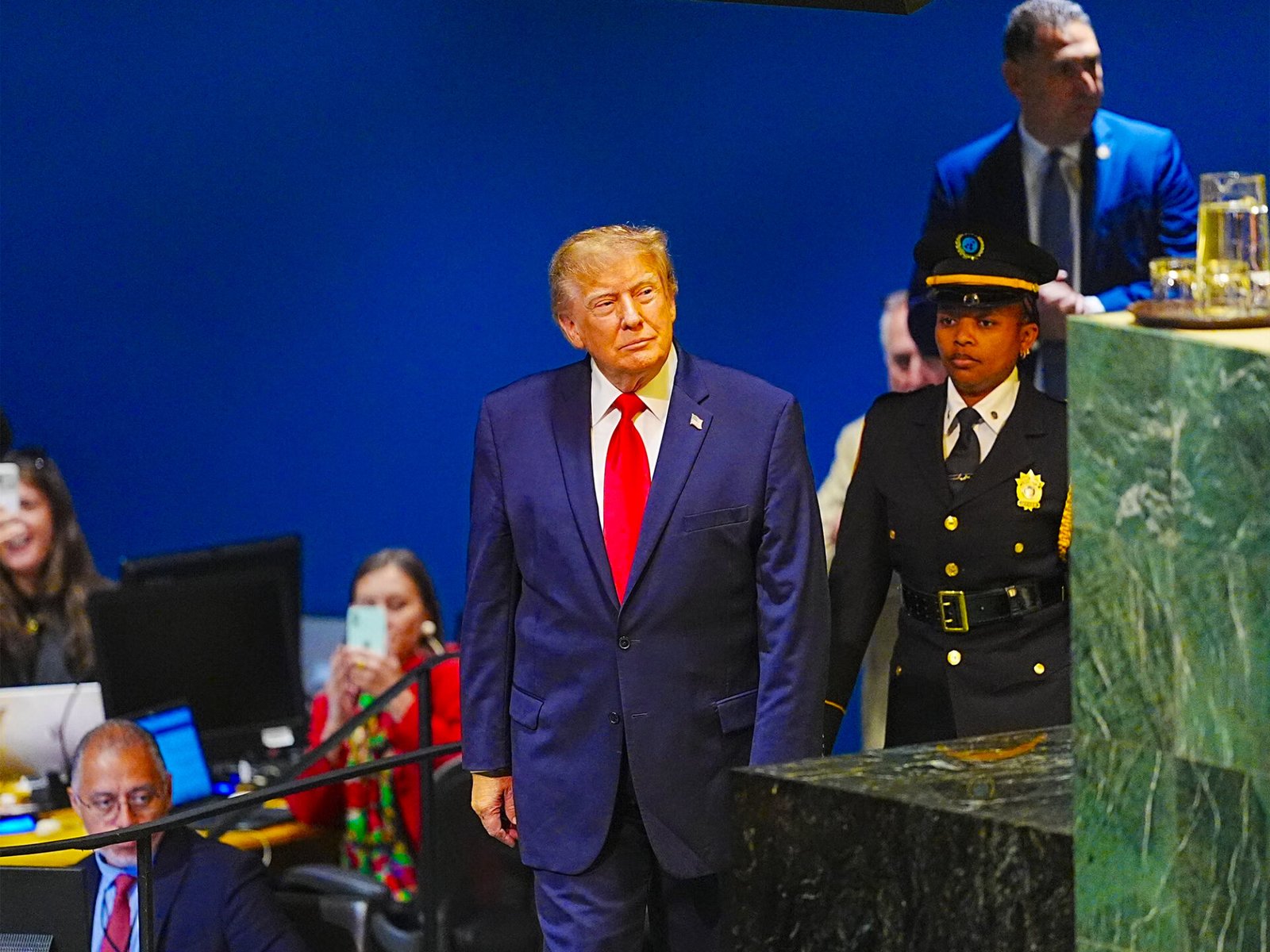
US President Donald Trump used his address to the United Nations General Assembly in New York to defend his administration’s foreign policy, warn Iran of further military action and outline positions on artificial intelligence, climate change and international institutions.
Trump’s 37-minute speech on 22 September 2026 covered the war involving Iran, Russia’s war in Ukraine, US relations with other countries, Greenland, artificial intelligence and the role of the United Nations. Reuters reported that Trump warned he could “annihilate” Iran if no peace agreement is reached and said he expected a deal after the US midterm elections.
The speech also included a proposal to refer to artificial intelligence as “super intelligence”, according to Reuters. Trump said the United States was leading China in the technology and argued against measures that could slow its development.
Trump’s comments on AI come as governments continue to debate how rapidly developing systems should be governed. Australia By Aussie previously reported on former Australian chief scientist Alan Finkel’s call for greater US-China cooperation on international AI rules in its earlier coverage of AI regulation.
Climate change was another major subject. Trump rejected warnings about climate risks and argued that the global climate was cooling. The Guardian opinion article that prompted this report disputed that assessment and pointed to recent temperature records and scientific reports. Australia By Aussie has also covered research finding that seven of Earth’s nine planetary boundaries are currently outside the identified safe operating space, including the climate system, in earlier coverage of the planetary boundaries assessment.
Trump also criticised the United Nations and the International Criminal Court, while discussing US security interests in Greenland and Venezuela. Reuters reported that he called on countries to support economic isolation of Iran and defended the US-Israeli campaign against Tehran.
On Ukraine, Trump said the United States was working with the Russian and Ukrainian leaderships and expressed confidence that the conflict could be brought to an end. The speech did not produce a new peace agreement.
The Guardian opinion article by historian and former White House speechwriter Ted Widmer argued that Trump’s address represented a shift away from traditional US appeals to international cooperation and persuasion. Those assessments are Widmer’s interpretation of the speech rather than an official description of US policy.
The speech comes during the 81st session of the UN General Assembly, where world leaders are discussing conflicts, climate change, artificial intelligence and the future role of international institutions. The United States remains a major participant in those discussions, while Trump’s administration continues to pursue a foreign policy centred on US military and economic power.
Source: The Guardian