

Australians are being asked to accept the costs of a rapidly expanding artificial intelligence and data centre industry before they can see clear benefits, with growing opposition in the United States offering a warning for the Albanese government.
The debate is becoming more pressing as investment in large data centres adds to demand for workers, materials and technology at a time when the Reserve Bank of Australia is already warning about inflationary pressures. The central question is whether the promised productivity gains will reach ordinary households — and when.
Reserve Bank governor Michele Bullock identified data centre-related investment as one contributor to stronger-than-expected demand when the bank raised interest rates to an 18-year high. She said the investment had added to inflationary pressure while the domestic economy was already constrained.
The RBA has not offered a timetable for when artificial intelligence will begin delivering a meaningful positive effect on inflation. Bullock said that if AI substantially improved productivity, it could support faster economic growth, but cautioned that this would not necessarily mean lower interest rates.
The scale of the investment pipeline is substantial. Deloitte Access Economics reported that Australia had 37 data centre projects in its $1.39 trillion investment pipeline, with a combined value of $141 billion — a 36 per cent increase in a year.
Deloitte director Sheraan Underwood said the expansion was competing with housing and infrastructure projects for workers and materials. The firm warned that construction demand and inflation pressures were arriving immediately, while the productivity dividend could take much longer to emerge.
Although building data centres can create construction activity, the direct economic return may be more limited than the headline investment figures suggest. Much of the technology used to equip the facilities is imported, and relatively few workers are required to operate them once construction is complete.
The political challenge for Prime Minister Anthony Albanese is to explain how the expansion will improve the lives of Australians, rather than simply asking communities and households to absorb its near-term costs. Labor is considering a plan to attract more AI investment, while public questions remain about electricity and water use, jobs, copyright and the pressure on local infrastructure.
Opposition to data centres has become more visible in the United States. Reporting cited in the original analysis pointed to polling that found half of Americans opposed facilities near their homes, while NBC exit polling found 56 per cent of voters considered AI and data centres a crucial or major factor in the US midterm elections. Local ballot measures seeking restrictions on construction also recorded strong support.
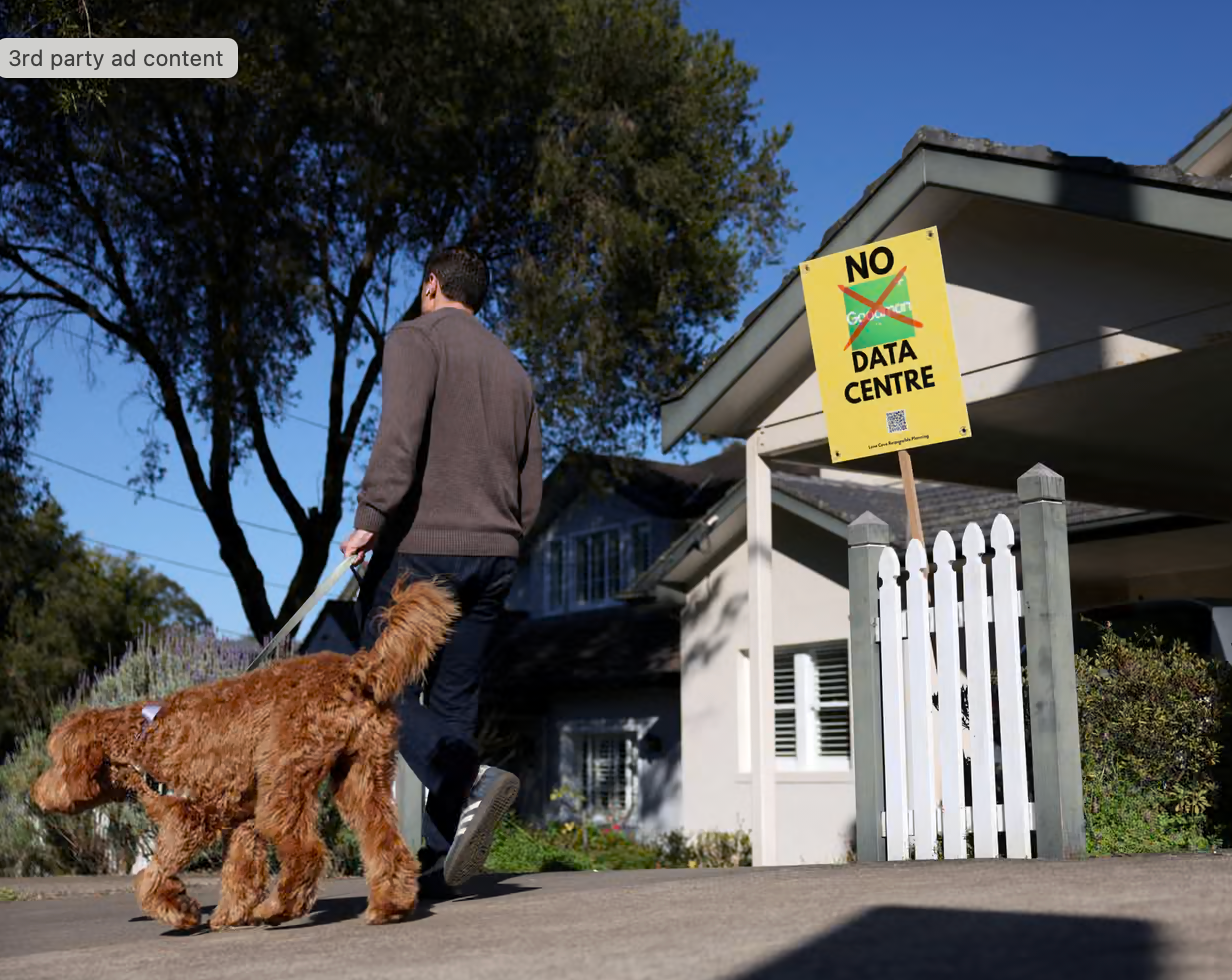
Australia’s backlash remains smaller, but community groups are organising and protesting against proposed developments. The photograph accompanying this article shows a person walking a dog past a sign opposing a Goodman data centre. It illustrates the local opposition visible in the image, without establishing any additional details about the protest or the proposal.
The debate is also unfolding alongside arguments over how governments should respond to inflation. Senator David Pocock has proposed a Senate committee to examine alternatives to relying on monetary policy alone. Options raised include temporary progressive changes to income tax or superannuation, as well as taxes on windfall profits and gas exports.
Independent economist Saul Eslake has suggested that increasing the superannuation contribution rate from 12 to 13 per cent could reduce household spending. These proposals form part of a wider discussion about who should bear the cost of managing inflation while major technology investment continues.
Australia’s data centre expansion is expected to support wider AI use, automation and productivity over time. But the economic benefits remain uncertain in their timing and scale. As the US experience demonstrates, public support cannot be assumed if communities see the immediate demands of the industry but are not convinced that the gains will be shared.
Based on analysis by Josh Butler, published by The Guardian on 5 November 2026.