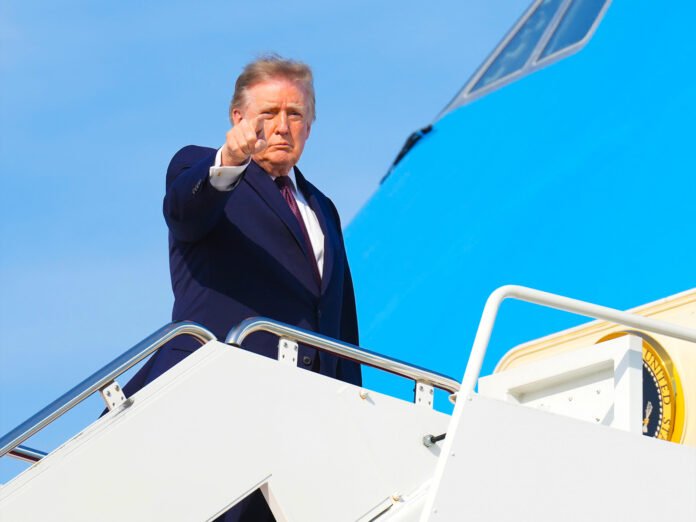
US President Donald Trump has threatened to double tariffs on imports from South Korea if Seoul does not move quickly to support a proposed $54 billion liquefied natural gas project in Alaska.
Trump made the remarks on Friday, 2 October, as he left the White House for a campaign rally in Alabama. He was asked about South Korean officials pushing back against his earlier announcement that Seoul had agreed to fund the Alaska LNG pipeline.
Trump said he had not announced the investment prematurely and indicated that he could increase tariffs if South Korea did not proceed. His comments came after South Korean officials said the country had only agreed to begin reviewing the project’s commercial viability and legal requirements, rather than making a final investment commitment. Reuters reported that the disagreement centres on whether the Alaska project has been formally committed to as part of the wider investment package.
The proposed Alaska LNG project would involve an approximately 800-mile pipeline carrying natural gas from Alaska’s North Slope to an export terminal near Nikiski. Reuters has reported estimated total project costs of roughly $44.5 billion to $54.5 billion, with the high cost of the pipeline, gas treatment and liquefaction facilities raising questions about its commercial viability.
Trump had announced the $54 billion figure as part of a broader South Korean investment programme in the United States. The wider package stems from the US-Korea trade agreement reached in 2025, under which South Korea committed to $350 billion in US investments while the United States agreed to a 15 per cent tariff rate on Korean goods under the terms outlined by the two governments.
South Korean officials have since drawn a distinction between the broader investment commitments and the Alaska LNG project. Seoul has said the Alaska project remains subject to commercial and legal review and that no final decision had been made on the investment amount.
The dispute adds uncertainty to a project that has been promoted by Trump and Alaska officials as a major energy infrastructure development. The proposed pipeline is intended to move gas from Alaska’s North Slope to an LNG export facility, with Asian markets among the potential destinations.
Trump’s tariff threat also highlights the way trade policy is being linked to investment negotiations. The 2025 US-Korea agreement set a 15 per cent tariff framework for Korean goods, alongside major Korean investment commitments in areas including shipbuilding and strategic industries.
Tariffs are legally collected from importers bringing goods into the United States, rather than being a direct payment made by the foreign government to Washington. US Customs and Border Protection administers the duties, while the ultimate economic burden can be shared through changes in prices, margins and supply chains. Congressional Research Service analysis has also noted that US importers pay the tariff to the US government, although the broader economic incidence can vary.
The disagreement over Alaska LNG follows other recent differences between Washington and Seoul over how elements of the investment package should be interpreted. Reuters reported that South Korean officials were also surprised by a separate US announcement concerning an $8.4 billion enhanced oil recovery project.
For now, the Alaska LNG investment remains subject to further discussions and assessments by South Korean authorities. Trump’s latest comments raise the possibility that the project could become tied more directly to the tariff relationship between the two countries if no agreement is reached.
Neither the threatened tariff increase nor the $54 billion Alaska LNG investment should be treated as a completed transaction at this stage. The key unresolved issue is whether South Korea will ultimately approve participation in the project and on what commercial terms.