

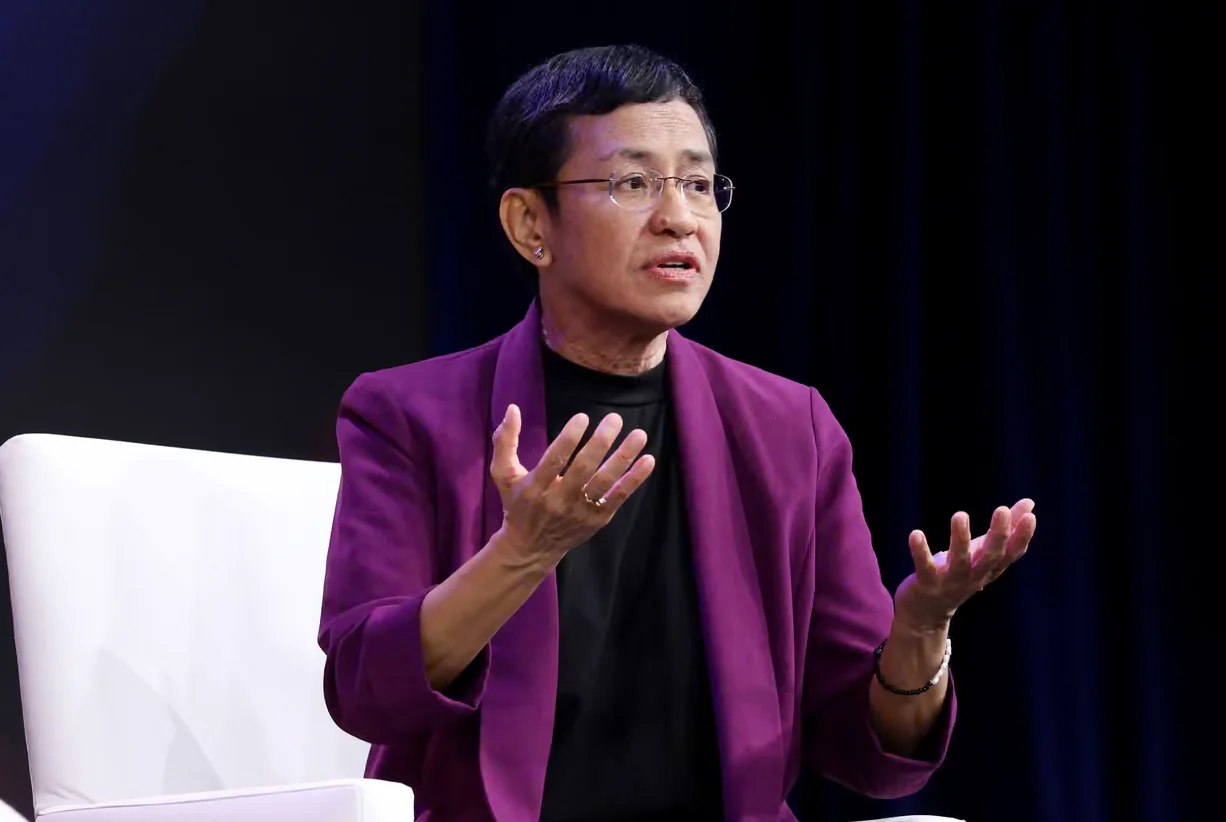
Nobel Peace Prize laureate and journalist Maria Ressa has warned that unchecked power held by major technology companies is becoming a serious threat to democracy, alongside the rise of authoritarian political leaders.
In an interview with The Guardian, the Filipino-American journalist said her new book, The Fight Back: A Citizen’s Guide to Standing Up to Dictators, examines how authoritarian governments and powerful technology companies can reinforce one another while operating with limited public accountability.
Ressa pointed to the Philippines under former president Rodrigo Duterte as an early example of how social media can be used to target critics, spread disinformation and shape public debate. She co-founded the independent news organisation Rappler in 2012 and faced online harassment and a series of legal cases linked to its reporting.
Ressa and Russian journalist Dmitry Muratov received the Nobel Peace Prize in 2021 for their efforts to safeguard freedom of expression.
She argues that the risks now extend beyond the Philippines. In her view, technology platforms can help political leaders distribute propaganda and weaken opposition, while major technology companies benefit from government contracts, deregulation and reduced scrutiny.
Ressa singled out Meta chief executive Mark Zuckerberg in her criticism, describing the concentration of influence among technology executives as a problem of power and accountability. She also raised concerns about Elon Musk’s ownership of X and the influence the platform can have over public information.
She said recommendation systems that reward anger, fear and sensational content can distort public discussion. Ressa also criticised the use of artificial intelligence in information systems when accuracy and facts are not adequately prioritised.
The journalist argues that governments should regulate technology companies more effectively, saying decisions made by platforms can affect public safety and the information people rely on.
Ressa’s book sets out practical steps for readers, including reviewing how much time they spend on social media and considering whether particular apps are increasing their exposure to anger-driven content.
Her warning is that democracy depends not only on elections and political institutions, but also on reliable information, independent journalism and accountability for those who wield significant power over public debate.