

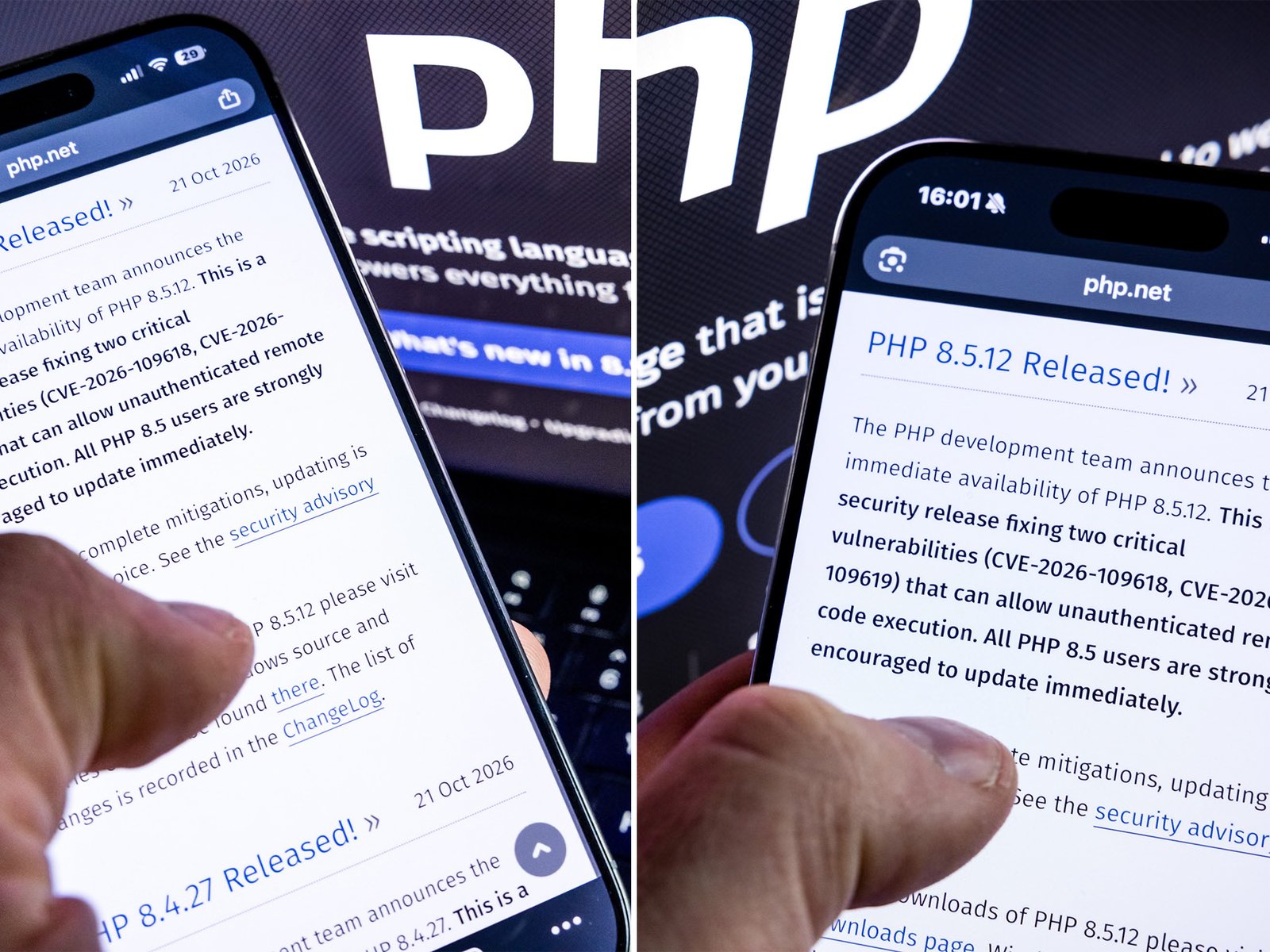
Two critical vulnerabilities in PHP, the programming language used by WordPress and a large share of the web, have prompted emergency security updates and temporary website shutdowns as organisations race to protect internet-facing servers.
The flaws, tracked as CVE-2026-109618 and CVE-2026-109619 and known collectively as PHP2Shell, can allow an unauthenticated attacker to execute code remotely on a vulnerable server. Depending on the server and configuration, successful exploitation could expose sensitive memory or give an attacker access to files and databases. Both vulnerabilities have been rated critical, with a CVSS v4 score of 9.2.
The PHP development team released patched versions on 21 October: PHP 8.5.12, 8.4.27, 8.3.36 and 8.2.35. Administrators should install the appropriate fixed release for their supported branch or check with their operating-system or hosting provider for a vendor-supplied patch. PHP 8.1 and older branches no longer receive routine security releases from the project, although some vendors may provide backported fixes.
PHP is a server-side scripting language used to build dynamic websites and applications. WordPress, Drupal and many other publishing and content-management systems rely on it, so a flaw in the PHP runtime can affect sites regardless of which theme or plugin they use. The PHP Foundation has said the weaknesses involve memory handling and error processing used across ordinary web requests, making the problem difficult to address without risking compatibility or performance.
Some organisations temporarily took services offline while applying updates, but a shutdown does not by itself mean a website was hacked. Security teams have warned that exploitation attempts have been observed and that unpatched internet-facing systems are at heightened risk. Amazon Threat Intelligence reported activity targeting a honeypot before public disclosure, although it remained unclear how the actor obtained details of the vulnerability.
The disclosure timeline was brought forward after information about the vulnerabilities began circulating before the planned release. The PHP team had coordinated the release with security researchers and software distributors so fixes could be prepared in advance. Security researchers have also described a role for artificial intelligence in finding the flaws, illustrating how AI tools can accelerate defensive research while potentially helping attackers identify weaknesses more quickly.
The incident is relevant to Australia because government and business services rely on PHP-based platforms, including Drupal deployments. Website owners should identify every PHP instance they operate, apply the appropriate security update, restart the relevant PHP workers or services so the fix is active, and review logs and files for signs of compromise. A software update closes the known vulnerabilities, but it does not remove malicious code that may already have been installed.
PHP’s security team says updating to a fixed version is the only complete remediation. If an organisation cannot patch immediately, it should follow the official advisory and its hosting provider’s guidance, and consider taking vulnerable services offline until they can be secured. Older unsupported versions need particular attention because routine fixes may not be available.
