

Australia connected more large-scale battery storage in the first six months of 2026 than during the whole of 2025, while new renewable generation projects secured more financing in the same period than across the previous year, according to the Clean Energy Council’s latest investment report.
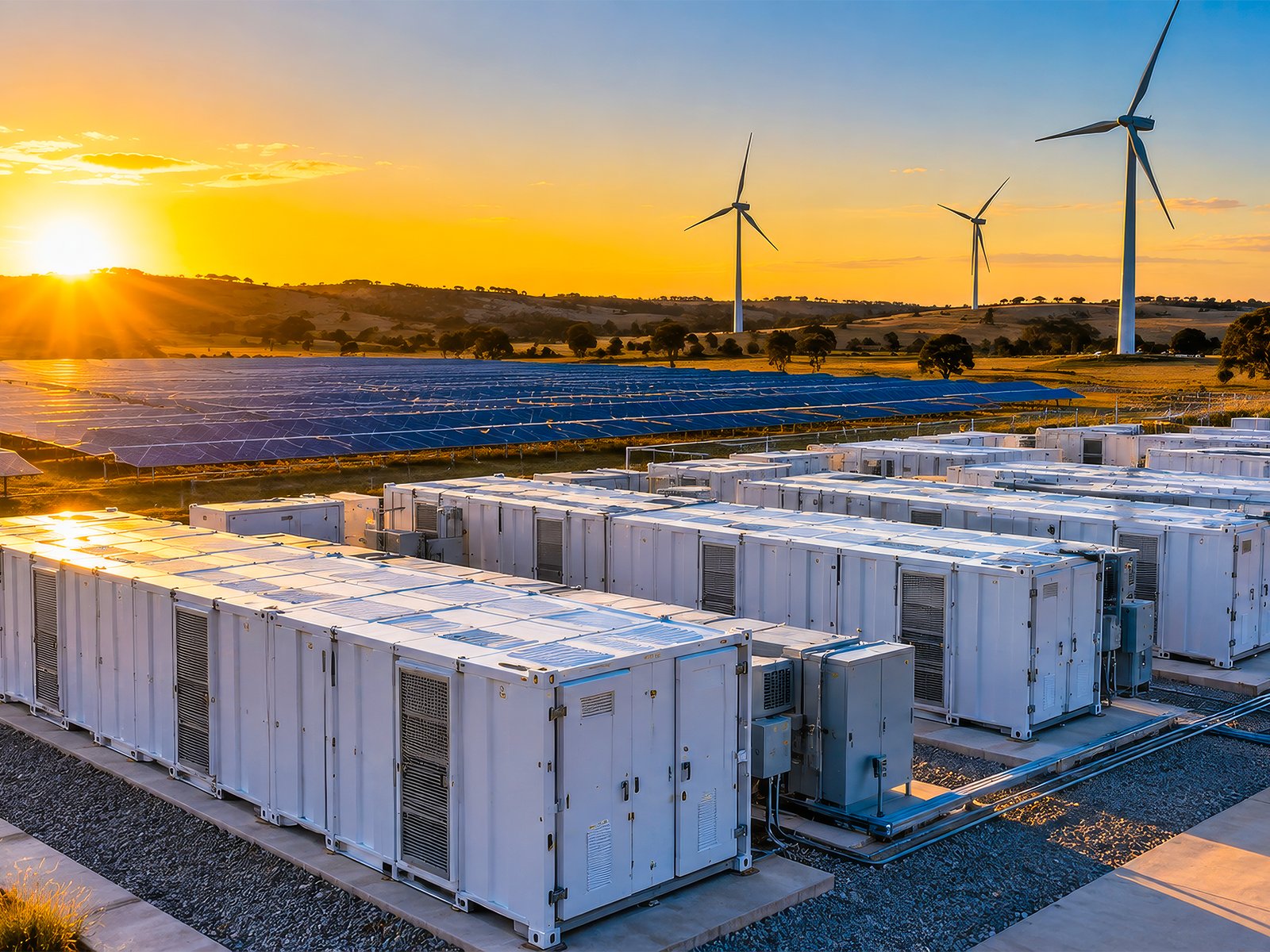
Nine utility-scale battery projects were switched on between January and June, adding 2.3 gigawatts of power capacity and 7.1 gigawatt-hours of storage. That exceeded the 5.1GWh added across all of 2025. The projects were valued at about $4.3 billion, according to the industry body’s report.
The figures describe two different measures: gigawatts indicate how much power a battery can deliver at a given moment, while gigawatt-hours measure how much energy it can store. The added storage gives the electricity system more capacity to retain surplus power and release it when demand rises, including during the evening peak.
The report also found that 12 renewable generation projects with a combined capacity of 2.6GW reached financial close in the first half of 2026, compared with 2.3GW over the whole of 2025. Reaching financial close means a project has secured the financing needed to proceed, but it does not mean the facility is already operating. Solar and solar-hybrid developments accounted for 11 of the 12 projects.
Five generation projects, representing 1.4GW of capacity and more than $2.8 billion in investment, began operating during the six-month period. They included the first stage of the Golden Plains Wind Farm in Victoria. A further eight projects totalling 1.9GW began construction.
Battery investment continued beyond projects already connected to the grid. Thirteen additional storage projects, representing 1.6GW of power capacity and 6.5GWh of energy storage, reached financial close during the half-year, according to the report. Those projects have secured financing but still need to progress through development and construction before they can supply the grid.
The Clean Energy Council said the results showed renewable investment continuing despite a difficult economic environment. Chief executive Jackie Trad argued that domestic wind and solar resources could help reduce Australia’s exposure to international fossil-fuel price shocks and supply disruptions. That is the industry group’s assessment of the benefits; the report’s project figures alone do not establish how much household bills will change.
The report also points to a difference between investment commitments and energy infrastructure already delivering electricity. New projects can take years to move from financial close to full operation, and their contribution depends on construction, grid connections and the timing of demand. The first-half figures therefore show both a rise in operating battery storage and a pipeline of projects still to be built.
The Clean Energy Council’s bi-annual report on large-scale renewable generation and storage for January to June 2026 sets out the project data and compares investment and commissioning activity with 2025.