


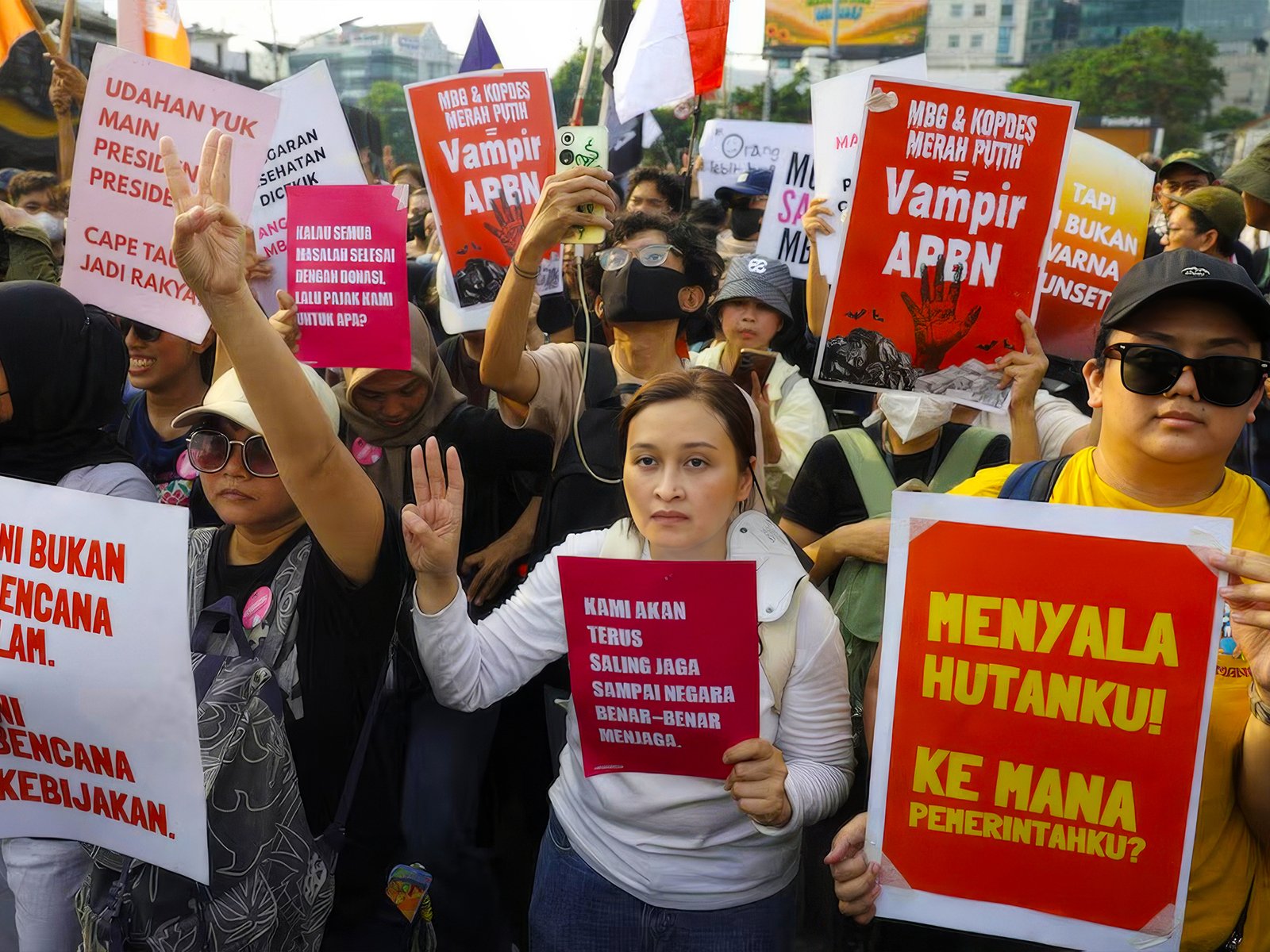
Indonesia is entering the third year of President Prabowo Subianto’s term amid renewed protests and signs of growing public frustration over living costs, government programmes and the response to forest fires.
Students and civil society groups have staged demonstrations in several cities, including over fires burning in Sumatra and Kalimantan. Protesters have called on the government to declare the fires a national disaster, while officials have said that step is not currently necessary.
Approval polls show sharply different readings
A survey by Saiful Mujani Research and Consulting (SMRC), conducted from October 1 to 10 and reported ahead of the president’s second anniversary, found that 44.5 per cent of respondents were satisfied with Prabowo’s performance. That was down from 81.2 per cent in November 2025, according to the same polling series. Reuters reported the survey included 1,213 respondents and had an estimated margin of error of 2.9 percentage points.
However, the figures are not the only recent measure of public sentiment. A separate survey by Parameter Politik Indonesia, published by the government’s presidential office, reported 65.2 per cent satisfaction with Prabowo. The surveys used different research organisations and methods, so their results should not be treated as directly interchangeable.
Free school meals face scrutiny
The president’s flagship free nutritious meals programme is another source of debate. It was designed to address undernutrition, but the initiative has faced criticism over food-poisoning incidents, implementation and its cost. Reuters reported that more than 57,000 food-poisoning cases had been recorded since the programme began, while critics have questioned its budget priorities. The government has said it is improving implementation and has disputed criticism about education funding.
Indonesia’s Constitutional Court has also ruled that, from 2028, the programme must no longer be financed from the education budget. The government says it has increased the overall national education budget and expanded incentives for teachers.
Economic concerns and wildfire response
Some young voters interviewed by the ABC said they had expected more job opportunities, affordable essentials and stronger economic performance. The rupiah has also come under pressure, while concerns about policy uncertainty have added to debate over the country’s economic outlook.
Forest fires have added to public frustration. Smoke from fires in Sumatra and Kalimantan has affected communities and neighbouring countries, including Malaysia and Singapore. Indonesia’s government says Prabowo is personally overseeing the response, has directed additional funding to seven provinces and deployed more than 71,000 personnel. The Forestry Ministry has said legal sanctions were issued against 32 companies.
Government says progress is being made
Prabowo acknowledged that more work was needed to meet public expectations but said his administration had achieved tangible results. Government representatives have also said students and young protesters have the right to express their views and that policy implementation would continue to be evaluated against data and public needs.
The political picture remains mixed: polling results differ, some young voters say they have withdrawn their support, and others continue to back the president while calling for improvements. The coming months will test how the government responds to concerns about household costs, public programmes and environmental emergencies.
Sources: ABC News reporting by Erwin Renaldi and Raffa Athallah; Reuters reporting on the October SMRC survey; Indonesia’s presidential office statement on the separate Parameter Politik Indonesia survey.