

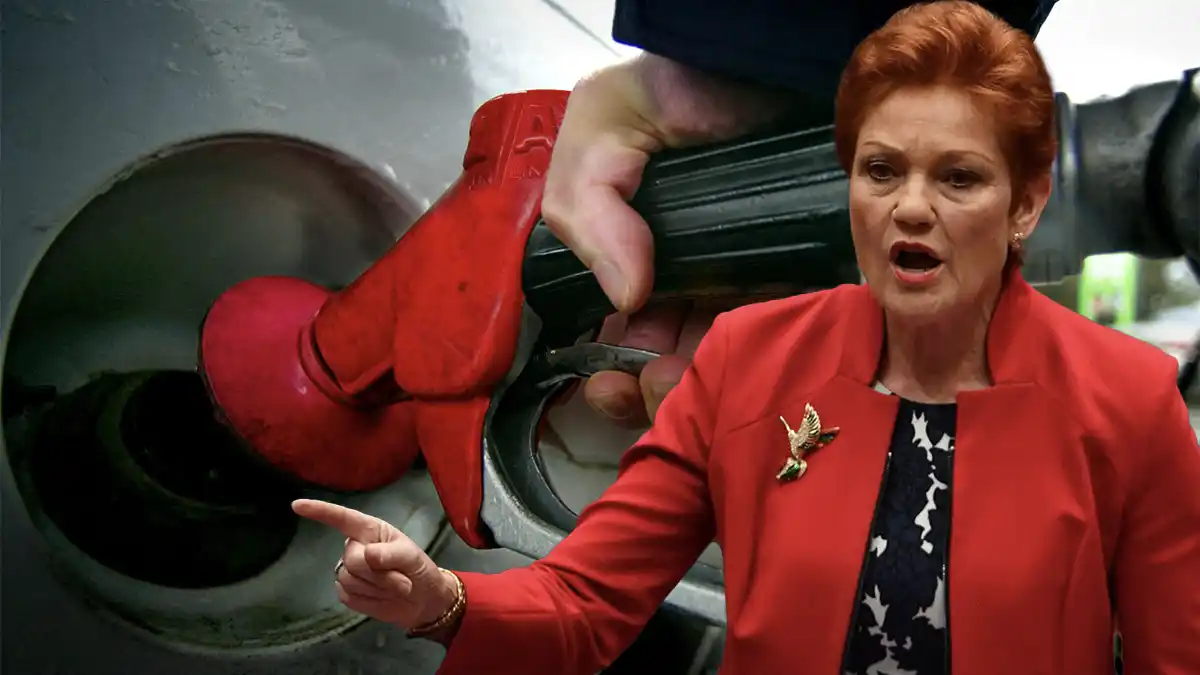
One Nation leader Pauline Hanson has warned that Australia is becoming increasingly vulnerable to fuel shortages, arguing the country’s shrinking refining capacity and reliance on imported fuel pose a growing national security risk.
In a statement posted on social media on 5 March, Hanson said Australia’s fuel reserves were running dangerously low and called on the federal government to prioritise fuel security as global energy markets face renewed volatility.
“Australia’s fuel stocks are running on empty,” Hanson wrote.
She claimed the country currently has about 25 days of diesel supply, 26 days of petrol and around 20 days of jet fuel, warning that supply disruptions could have severe consequences across the economy.
“A country that can’t fuel itself will end up with food shortages, hospitals going dark and the nation grinding to a halt,” she said.
Refinery closures and policy debate
Hanson linked Australia’s fuel vulnerability to the closure of domestic refineries over the past decade.
Australia once operated eight oil refineries, but industry restructuring and declining profitability have led to most facilities shutting down or converting to import terminals.
Only two refineries remain operating, leaving Australia heavily reliant on imported refined fuel.
Hanson argued the refinery closures occurred under both major political parties.
“Refineries closed down under both Liberal and Labor,” she said.
She also criticised what she described as an “obsession with net-zero” emissions targets, claiming climate policy had contributed to the decline of domestic refining capacity.
Energy policy experts have noted that refinery closures were primarily driven by economic pressures, including high operating costs and competition from larger Asian refineries.
Call for inquiry and fuel tax cut
Hanson said her party had previously called for a parliamentary inquiry into fuel security and Australia’s refining capacity.
She claimed the proposal was rejected by other parties.
“That’s why One Nation proposed an inquiry into fuel security and refining — which Labor and Greens teamed up to vote down,” she wrote.
As a short-term measure to ease rising petrol prices, Hanson also proposed reducing the fuel excise tax.
“The government could also provide immediate relief to Australians by cutting the fuel excise tax in half,” she said.
Broader fuel security concerns
Fuel security has become an increasingly prominent policy issue in Australia as the country’s reliance on imported fuel grows.
Under international energy agreements, countries are expected to maintain strategic fuel reserves equivalent to 90 days of net imports.
Australia has historically struggled to meet that benchmark domestically and has relied partly on stockpiles stored overseas under agreements with partner countries.
Concerns about supply vulnerability have intensified as global oil markets respond to geopolitical tensions and disruptions to shipping routes.
Analysts say the debate over fuel security is likely to remain central to Australia’s energy and defence policy in the coming years.

2 Comments
All these people criticising this new freeway because it takes them onto the M5 my advice to you all Simply don’t use it ,because I certainly will be .
Cut or cap the fuel tax and use a set amount of it to subsidise a rebuild of refineries IE 0.25c for every litre sold to pay for rebuilding training etc until they are up and running. Then figure out how much tax they need out of the fuel tax and adjust accordingly.
It’s not that hard.
And for electricity issues. Look at fast reactor helium fusion cleanest energy on the planet. That will sort us all out.
I’m sick and tired of all these lies.