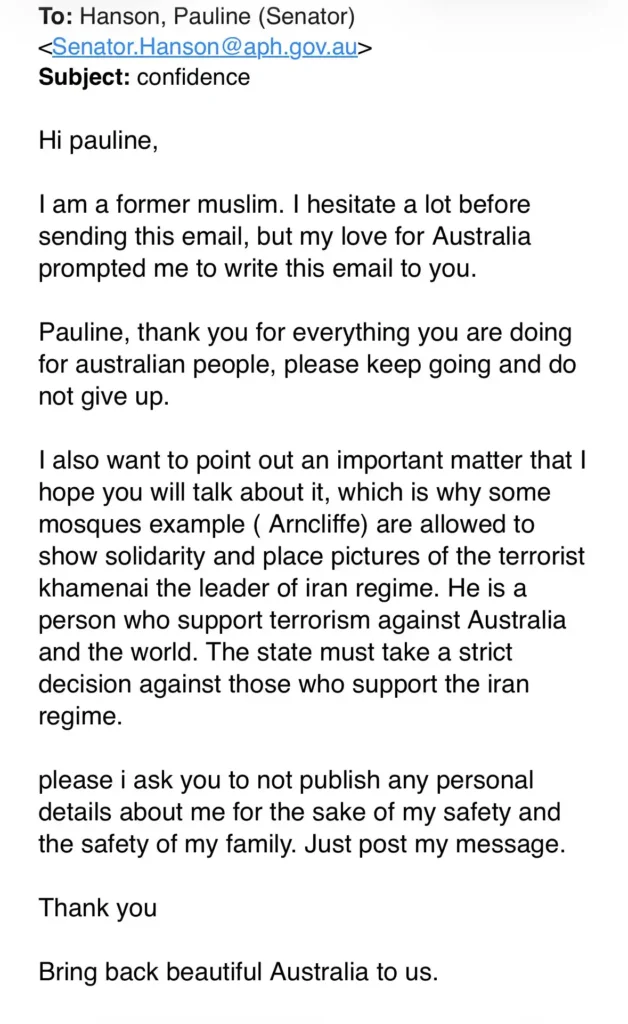

A social media post by One Nation leader Pauline Hanson has sparked debate online after she shared a screenshot of an anonymous email claiming some Australians are afraid to speak publicly due to concerns about extremism.
Hanson published the message on her account on X on Friday, accompanied by a caption arguing that Australians had been “silenced for too long”.
“Here’s a message from someone who can’t speak out because their safety would be threatened by extremists,” Hanson wrote.
Anonymous message raises allegations
The email, which appeared to be addressed to Hanson’s parliamentary office, claimed to have been written by a “former Muslim” who said they feared retaliation if their identity were revealed.
The sender thanked Hanson for her political stance and urged her to continue raising issues they believed were affecting Australia.
The message also referenced allegations that some mosques were displaying images of Ali Khamenei, the Iranian leader, and called for stronger government action against individuals or groups supporting the Iranian regime.
The email requested that Hanson not publish any identifying details about the sender.
The claims contained in the message have not been independently verified.
Online reaction divided
The post quickly attracted attention on social media, generating tens of thousands of views and prompting a mixture of supportive and critical responses.
Some users praised Hanson for highlighting what they described as concerns about extremism and national security.
Others criticised the decision to share an anonymous and unverified message, arguing that public figures should exercise caution when amplifying claims that cannot be independently confirmed.
One commenter accused Hanson of promoting divisive rhetoric, while another said the message reflected genuine fears among some Australians.
Broader political debate
The exchange comes amid wider debate in Australia about extremism, social cohesion and the balance between national security and community relations.
Australian security agencies monitor threats from a range of ideological sources, including religious extremism and politically motivated violence.
Government officials have repeatedly stressed that the overwhelming majority of Australians of all faiths reject extremism.
The controversy surrounding Hanson’s post illustrates the ongoing tensions within Australia’s political discourse as parties and commentators continue to debate how issues related to extremism and national identity should be addressed.