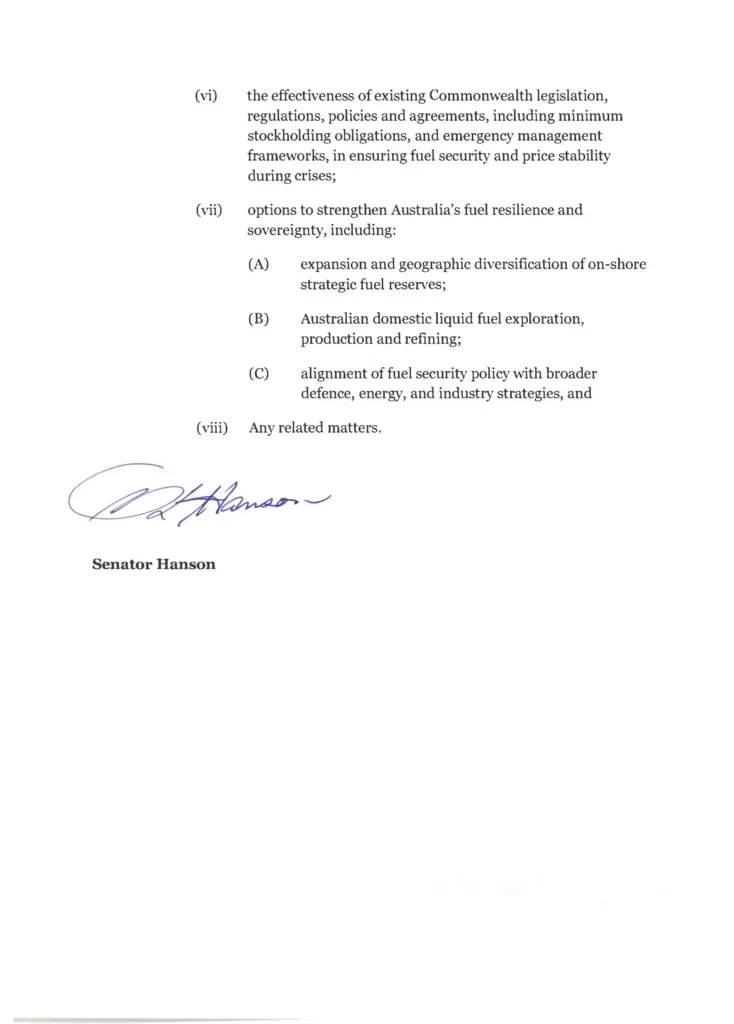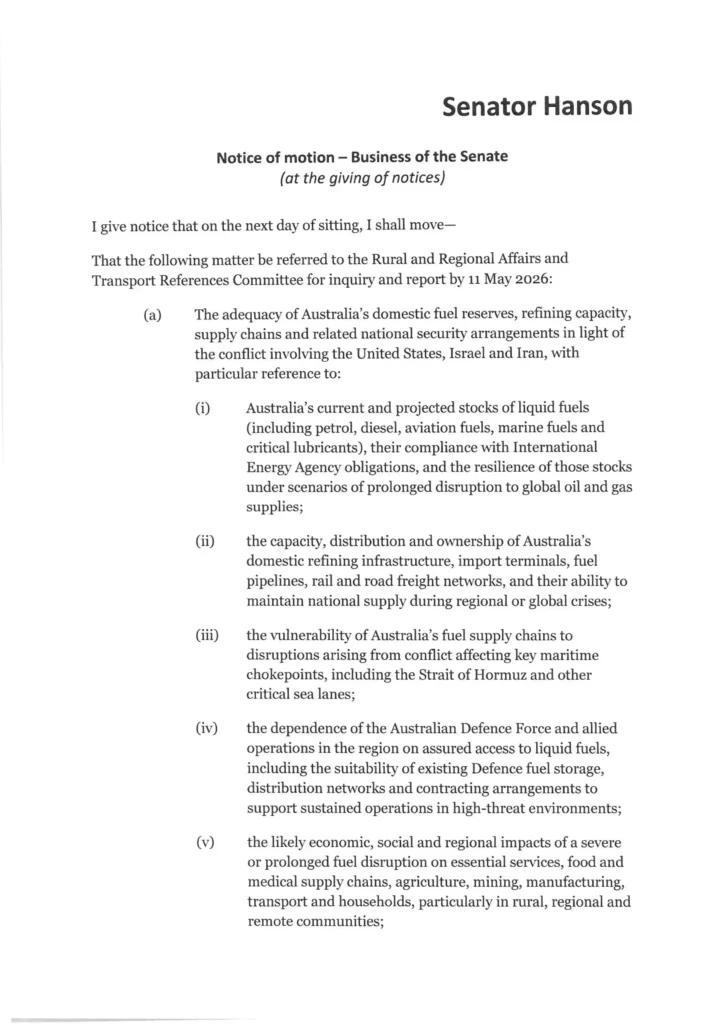

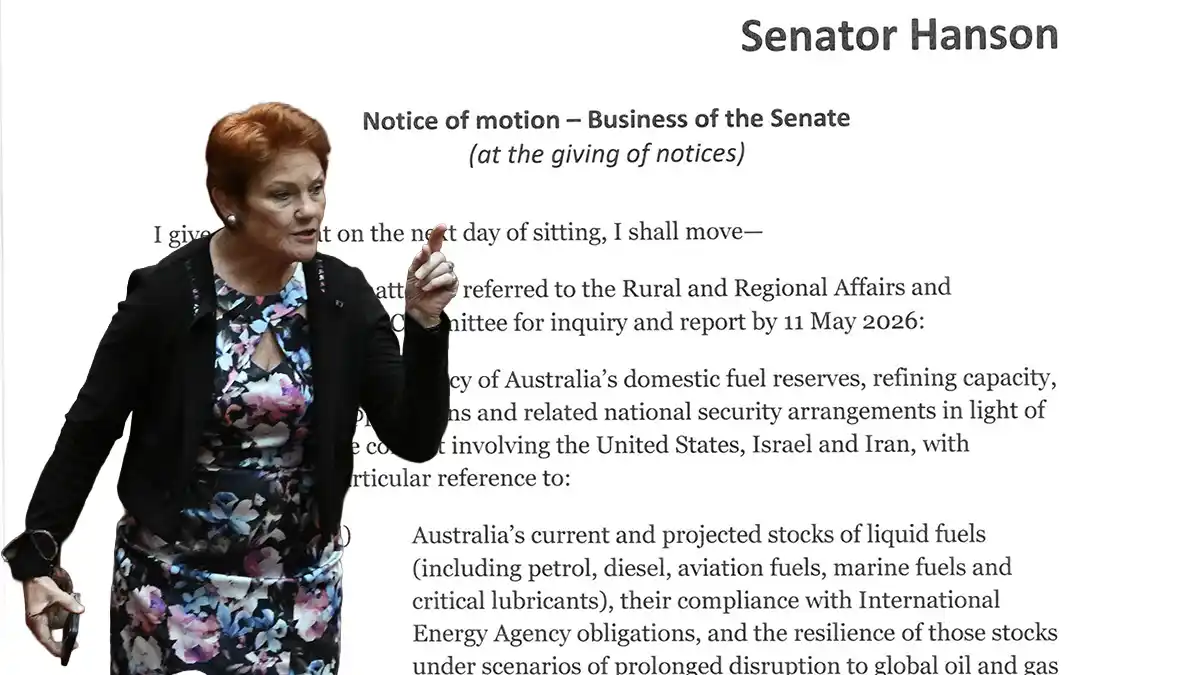
One Nation leader Pauline Hanson has criticised the federal government and the Greens after claiming a proposed Senate inquiry into Australia’s fuel security was blocked in parliament.
Posting on social media on 4 March, Hanson said Labor and the Greens had voted against establishing an inquiry that would have examined Australia’s declining refining capacity and dependence on imported fuel.
“Labor and the Greens just killed a Senate inquiry into fuel security and Australian refineries,” Hanson wrote.
Fuel security debate intensifies
Hanson said Australia’s shrinking refining sector had left the country exposed to global fuel price shocks.
“We used to refine almost all of our fuel here in Australia,” she said.
Australia’s refining industry has contracted significantly over the past decade. Several refineries closed as operators struggled with high costs and competition from large-scale refineries in Asia.
Today, only two major refineries remain operational in Australia — the Ampol refinery in Brisbane and the Viva Energy refinery in Geelong.
Hanson argued rebuilding domestic refining capacity would help shield Australia from international market volatility.
“This inquiry would have laid out a way to ensure more refining is done here in Australia so that we can insulate ourselves from international price spikes,” she said.
Net-zero policies blamed
The One Nation leader also criticised climate policies adopted by successive governments, claiming they contributed to the closure of refineries.
“Thanks to Net-Zero, we’re down to just two refineries,” she wrote.
Energy analysts, however, have noted refinery closures were largely driven by economic pressures including ageing infrastructure, declining profit margins and competition from modern refineries overseas.
Cost-of-living pressures
Hanson linked the fuel debate to broader concerns about household costs, warning Australians were already facing rising fuel prices and the prospect of further interest rate increases.
“Australians are rightly nervous about spikes in fuel prices,” she said.
“With an interest rate rise double whammy coming up, the cost of living crisis is getting even worse.”
Political divide over energy policy
Fuel security has become a growing policy issue in Australia as domestic refining capacity declines and global energy markets remain volatile.
Hanson said her party would pursue policies aimed at restoring local refining capacity and reversing net-zero emissions commitments.
“One Nation would end Net-Zero and refine fuel here,” she said.
The comments prompted a wave of responses online, with some users supporting calls for stronger domestic fuel production while others argued refinery closures were primarily economic decisions rather than the result of climate policy.
The debate reflects broader divisions in Australia’s energy policy discussions as the country balances energy security, economic pressures and climate commitments.