


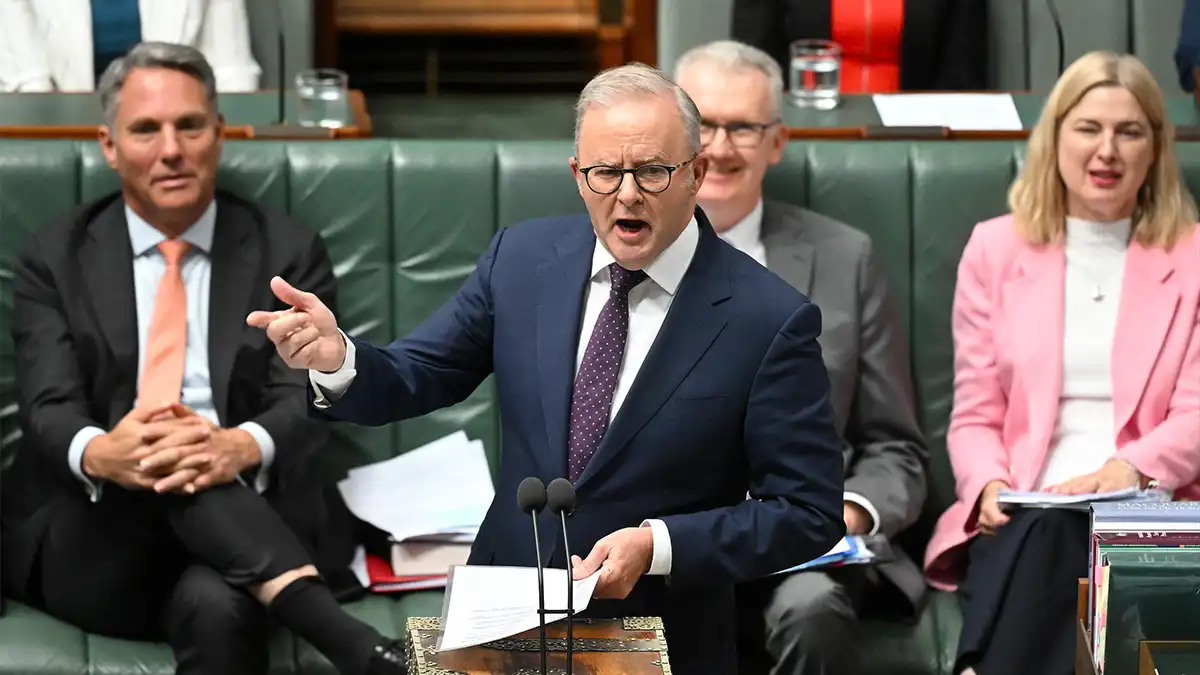
Speaker Milton Dick has sharply rebuked MPs during a heated question time in the House of Representatives, condemning what he described as “childish” and “snide” behaviour as government and opposition members traded increasingly personal attacks over the state of the Australian economy.
The intervention came as tensions rose in the federal parliament during a series of questions from Coalition MPs about declining living standards and responsibility for the country’s economic performance.
Liberal frontbencher Angie Bell asked Prime Minister Anthony Albanese whether he accepted responsibility for what the opposition claims is a deterioration in Australians’ living standards, repeating a line of questioning pursued by several Coalition MPs during the session.
As Albanese began responding, opposition MPs rose to challenge the relevance of his answer, prompting loud exchanges across the chamber.
Speaker Milton Dick quickly intervened as the noise level escalated.
“This is beyond a joke, the way the childish, snide remarks are being added in,” Dick told the chamber.
“It’s not dignified. So, I don’t know how else to explain it. I can only imagine what the gallery thinks.”
The Speaker’s comments reflected growing frustration with the increasingly combative tone of the debate, as members from both major parties shouted across the chamber.
Question time on Wednesday was dominated by arguments about the economy following the release of the latest national accounts figures earlier in the day.
Coalition MPs repeatedly argued that Australian households are experiencing a prolonged decline in living standards and sought to press the government on whether the prime minister should accept responsibility.
Opposition treasury spokesman Angus Taylor claimed Australians had “endured the longest household recession on record”, arguing the government’s economic management had failed to ease cost-of-living pressures.
Taylor asked whether the prime minister accepted that “the buck stops” with him for the country’s economic performance.
Albanese rejected the claim, accusing the opposition of ignoring key economic indicators released in the latest national accounts.
“They come in here with Monday’s pack of questions that they forgot to ask,” Albanese told the chamber.
“They’re ignoring today’s figures on the national accounts, completely ignoring the growth that is there, and they come in here and just continue to talk Australia down.”
The prime minister also accused the opposition of focusing more on internal political manoeuvring than economic policy.
“They’re not interested in the economy, they’re not interested in jobs, they’re not interested in living standards,” Albanese said.
“All they’re interested in is over who is next to jump into various positions.”
The heated exchanges continued as Nationals MP Michelle Landry repeated the opposition’s criticism, again asking the prime minister about declining living standards.
Albanese responded by pointing again to national accounts data showing the economy continuing to grow, arguing the opposition’s claims were inconsistent with the official figures.
The increasingly personal tone of the debate prompted further interruptions, including a point of order from opposition frontbencher Dan Tehan.
Albanese dismissed the interruption with a jab at his opponent, suggesting Tehan had risen because he “hasn’t been on TV for a minute”.
Speaker Dick again stepped in to calm the chamber, reminding MPs that the broad nature of the opposition’s questions meant the government was entitled to provide wide-ranging answers.
“I will keep saying it and hopefully it will get through,” Dick said.
The clash highlights the escalating political contest over economic management as the Albanese government prepares for its next federal budget.
While the government argues the economy is showing signs of resilience and growth, the opposition continues to focus on the financial pressures facing households, particularly rising mortgage costs, grocery prices and energy bills.
With cost-of-living concerns dominating the political agenda, question time exchanges over the economy are expected to remain a central battleground in federal politics in the months ahead.
