

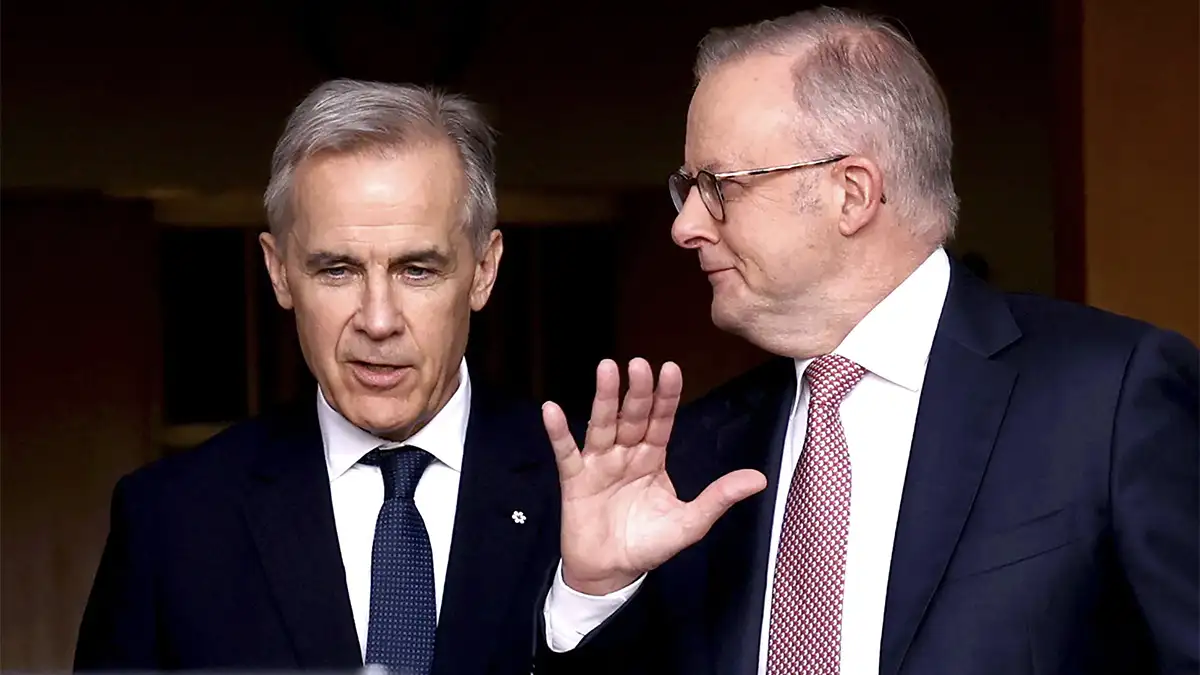
Canadian Prime Minister Mark Carney has urged countries such as Australia to work more closely together as “middle powers” in response to what he described as the breakdown of the post-second world war international order.
Carney delivered the message during a visit to Australia that included a speech at the Lowy Institute in Sydney and an address to the Australian parliament.
Speaking to lawmakers in Canberra, Carney argued that global power dynamics were shifting rapidly as major powers such as the United States and China compete for influence.
“The world will always be shaped by great powers,” Carney said. “But it can also be shaped by middle powers that trust each other enough to act with speed and purpose.”
Carney first outlined the argument earlier this year at the World Economic Forum in Davos, where he said the international system built after the second world war was undergoing a fundamental rupture.
During his Australian visit, he clarified that while the existing rules-based order may be weakening, countries should focus on building new forms of cooperation rather than attempting to restore the previous system unchanged.
“In a post-rupture world, the nations that are trusted and can work together will be quicker to the punch, more effective in their responses, more proactive in shaping outcomes,” Carney told parliament.
The visit highlighted the growing diplomatic relationship between Carney and Australian Prime Minister Anthony Albanese. The two leaders have met repeatedly since taking office and have promoted cooperation among democratic governments facing geopolitical and economic uncertainty.
During the visit, Australia and Canada announced plans to deepen collaboration on trade, defence cooperation, artificial intelligence and critical minerals supply chains.
Both governments see these sectors as central to economic security and technological competitiveness in the coming decades.
At the same time, Australia continues to deepen its defence ties with the United States and the United Kingdom through the AUKUS security partnership, which will see Canberra acquire nuclear-powered submarines.
The agreement, expected to cost at least $370bn over several decades, is one of the largest defence investments in Australian history.
Supporters argue AUKUS will strengthen Australia’s military capabilities and reinforce deterrence in the Indo-Pacific region.
However, critics have raised concerns that closer integration with US defence systems could limit Australia’s strategic independence.
The debate intensified after Prime Minister Albanese confirmed that three Australian Defence Force personnel had been onboard a US submarine that sank an Iranian warship during escalating tensions in the Middle East.
The government said the Australians were present as part of a training program and did not take part in the attack.
Strategic analysts say the episode illustrates the difficult balance facing Australia as it navigates an increasingly uncertain international environment.
While Canberra is seeking stronger partnerships with countries such as Canada and European allies, it remains deeply tied to the United States through longstanding military and intelligence arrangements.
Carney said cooperation among trusted partners could provide stability during a period of geopolitical disruption.
Starting anew, he said, offered an opportunity to build “something better, more prosperous, more resilient and more just”.
