


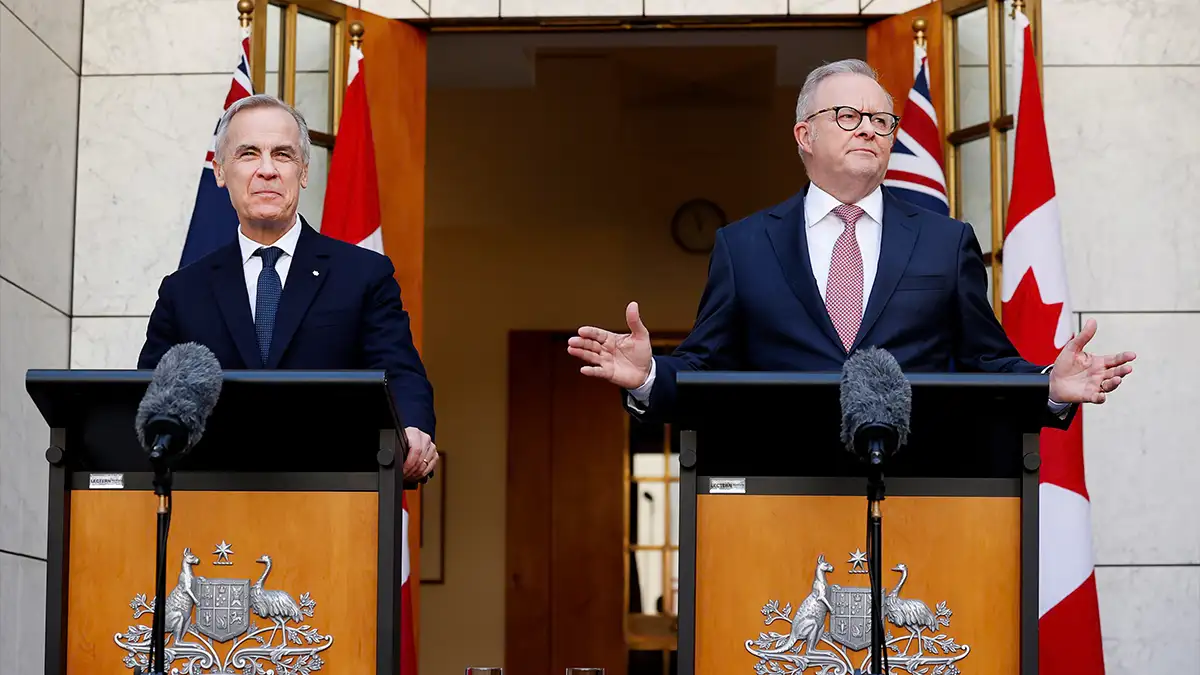
Canadian Prime Minister Mark Carney has called for deeper strategic cooperation between Australia and Canada, describing the two nations as “strategic cousins” that should work more closely together on defence, trade, critical minerals and artificial intelligence.
Carney delivered a rare address to a joint sitting of the Australian parliament in Canberra on Thursday, after meeting Prime Minister Anthony Albanese, cabinet ministers and advisers in the cabinet room at Parliament House.
Speaking to members of both houses, Carney argued that cooperation between so-called “middle powers” would be increasingly important in a world shaped by geopolitical competition and disruptions to the global economic order.
“In the old world, and even to a degree today, the temptation has been to see ourselves as competitors,” Carney told parliament.
“In this new world, we should be strategic collaborators.”
The Canadian leader said Australia and Canada could strengthen their position by negotiating and cooperating together when dealing with larger global powers.
Carney said he had travelled to Australia to reaffirm the long-standing alliance between the two countries and to explore new forms of collaboration in response to global instability.
“With that global architecture now breaking down from consecutive crises, I have come to Australia to reaffirm our alliance and to suggest where we can go next,” he said.
Cooperation on critical minerals and defence
Following Carney’s address, Albanese and the Canadian leader held a joint press conference where they outlined a series of new cooperation initiatives.
The two governments agreed to deepen collaboration on critical minerals supply chains, defence cooperation and artificial intelligence capabilities.
Albanese announced that Australia would join Canada’s G7 critical minerals production alliance, a partnership aimed at strengthening secure supply chains for minerals used in advanced manufacturing and clean energy technologies.
The prime minister said the two countries would also work to align Australia’s critical minerals strategic reserve with Canada’s defence stockpiling system.
Albanese said the partnership reflected the shared interests of both countries as democratic trading nations navigating a more volatile global environment.
“Peace, security and prosperity are not the preserve of the great powers alone,” he said.
“They are our common cause and our collective responsibility.”
The leaders also announced a new annual meeting of emergency ministers from both countries to strengthen cooperation on natural disaster response.
AI and emerging technologies
Carney used part of his address to highlight the growing role of artificial intelligence in global security and economic competitiveness.
He argued that countries such as Canada and Australia needed to develop sovereign AI capabilities and secure data infrastructure to maintain strategic autonomy.
“Strategic autonomy will require sovereign intelligence infrastructure,” Carney said.
“We know we must work with others who share our values to build sovereign AI capabilities so we are not caught between the hyperscalers and the hegemons.”
Canada is already working with European partners and India on AI initiatives, and Carney said Australia could become an important partner in those efforts.
Shared approach on global conflicts
Both leaders were questioned about the escalating conflict involving Iran during a joint press conference following the parliamentary address.
Albanese said the international community wanted to see a de-escalation of hostilities, but he argued that Iran must stop attacks across the region and abandon any pursuit of nuclear weapons.
“I want to see the possibility of Iran getting a nuclear weapon removed once and for all,” Albanese said.
Carney echoed the comments, saying Canada supported de-escalation but that it would require an end to attacks on civilians and efforts to prevent Iran from developing nuclear weapons.
“We want to see a broader de-escalation of these hostilities,” he said.
“But that cannot be achieved unless Iran’s ability to acquire a nuclear weapon and export terrorism is ended.”
Carney also said Canada could not completely rule out future participation in military action if required to defend its allies.
Vaccine manufacturing partnership
During the visit, Australia and Canada also announced a new pandemic preparedness partnership involving vaccine manufacturer CSL Seqirus.
Under the agreement, Canada will secure access to 15 million doses of influenza vaccine from CSL Seqirus if the World Health Organization declares a pandemic.
The vaccines would be produced at a new manufacturing facility near Melbourne Airport, which will be capable of producing more than 150 million vaccine doses during the first wave of production in a pandemic scenario.
The facility is expected to support a vaccine supply chain worth about $300 million annually to the Australian economy.
Canada’s health minister Marjorie Michel said the agreement would strengthen Canada’s ability to respond quickly to future health crises.
“This renewed contract with CSL Seqirus strengthens Canada’s ability to respond quickly to a potential future flu pandemic,” Michel said.
The Canadian prime minister’s visit marks one of the few occasions a foreign leader has addressed both houses of the Australian parliament.
