


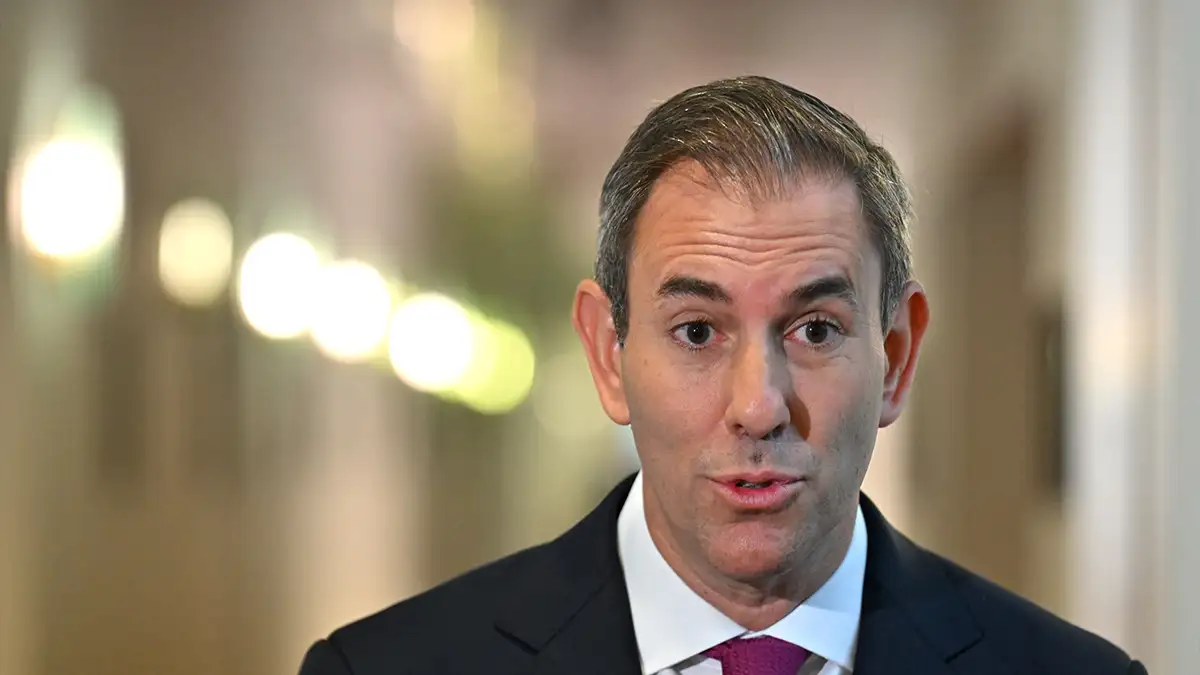
Australia’s treasurer Jim Chalmers says long-standing global political and economic assumptions are beginning to unravel, as governments confront a rapidly changing international landscape shaped by conflict and geopolitical rivalry.
Speaking on ABC Radio National Breakfast, Chalmers said the current period of global instability highlighted the need for stronger cooperation among countries often described as “middle powers”.
His comments came as Mark Carney visits Australia, where the Canadian leader has been promoting closer collaboration among countries that sit between the world’s major superpowers.
Carney has used his visit, including a speech at the Lowy Institute in Sydney, to argue that middle-power cooperation could play a larger role in responding to global crises.
Asked whether such alliances could help ensure military actions taken by major powers comply with international law, Chalmers said the purpose of middle-power cooperation extended beyond legal oversight.
“When it comes to the ways that a lot of the old certainties in the world and in the global economy are breaking down and busting up,” Chalmers said, countries such as Australia and Canada needed to strengthen engagement and cooperation.
“We believe that the best way to advance our national interest is to engage enthusiastically with Canadian friends and other middle powers, but also with the major powers,” he said.
“We believe in cooperation and in engagement.”
The comments come amid growing debate about the legality of recent military strikes carried out by the United States and Israel against Iran.
While Carney has suggested the action “would appear, prima facie … to be inconsistent with international law”, the Australian government has so far declined to take a public position on whether the strikes were lawful.
At the same time, Australia continues to coordinate flights bringing citizens home from the Middle East as the conflict escalates.
Foreign minister Penny Wong confirmed that three additional flights were scheduled to depart the United Arab Emirates for Australia.
Two flights are scheduled to land in Sydney, while a third is expected to arrive in Melbourne.
The first flight from Dubai to Sydney was scheduled to depart at 2am local time, with additional flights later in the day including one from Dubai to Melbourne and another from Abu Dhabi to Sydney.
More than 230 Australians arrived in Sydney the previous day on the first flight organised to bring travellers home.
Wong said the government continues to encourage Australians in the region to leave on commercial flights where possible while contingency plans remain in place should conditions deteriorate further.
