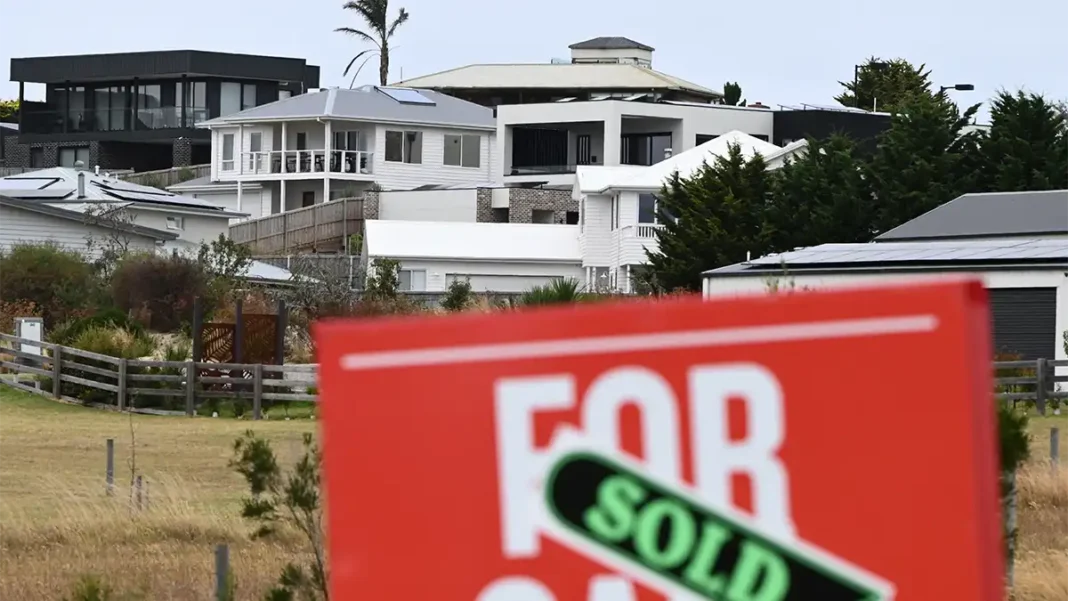


Australia’s land values have increased dramatically over the past 25 years, significantly reshaping household wealth and making homeownership increasingly unattainable for younger generations, according to reporting by The Guardiancolumnist and Australia Institute chief economist Greg Jericho.
Recent figures from the Australian Bureau of Statistics show that in 2025, total household wealth rose by $1,751 billion, with $859.8 billion of that growth — nearly 49 per cent — coming from increases in land value rather than buildings. Unlike dwellings, which depreciate, land has risen sharply in value and now makes up 42 per cent of all Australian household assets, up from 30 per cent in 1988.
For decades, homeownership was associated with providing shelter and stability, but today housing is increasingly treated as a wealth‑building investment. The rise in land values far outstrips growth in other asset types, including superannuation and bank deposits, contributing to widening intergenerational wealth gaps.
A major policy factor driving this trend is the 50 per cent discount on capital gains tax (CGT), introduced in 1999. The discount applies to investment properties held for more than 12 months, meaning only half of any profit from the sale of such property is included in taxable income. This tax concession incentivises property investment and is widely viewed as distorting the housing market in favour of investors rather than owner‑occupiers.
The result has been that land values have risen disproportionately compared with household incomes. In the 1990s, land held by households was about 1.5 times the value of annual household income, but now it is approximately 3.8 timesthat income.
Critics argue that the CGT discount benefits wealthier Australians disproportionately and fuels property speculation rather than increasing housing supply. A new analysis shows that the combination of the CGT discount and negative gearing — another policy allowing investors to deduct property losses against taxable income — has amplified investor activity and debt‑driven investment in the housing market, pushing up prices further.
Housing affordability remains a critical issue. According to separate reports, despite government targets to increase housing supply, infrastructure, planning delays and other constraints mean that large amounts of zoned land are not development‑ready, slowing the delivery of new homes.
The effects are most acute for younger Australians. As land values have surged, the gap between incomes and housing costs has widened. Many young people now face decades of saving before they can afford a deposit on a home, a situation documented in multiple housing affordability studies.
Political responses have been mixed. Independent MPs and the Greens support reducing the CGT discount to rebalance incentives away from investment properties and towards owner‑occupied housing. However, leading figures in the Liberal Party have opposed changes to the discount, arguing that homeownership remains a central part of the “Australian dream.”
With rising interest rates and global economic pressures affecting borrowing costs, housing market dynamics continue to pose challenges for aspiring buyers. As policy debate intensifies ahead of the May federal budget, many experts argue that major tax and housing reforms are needed to improve affordability and give younger Australians a fairer chance at owning a home.