

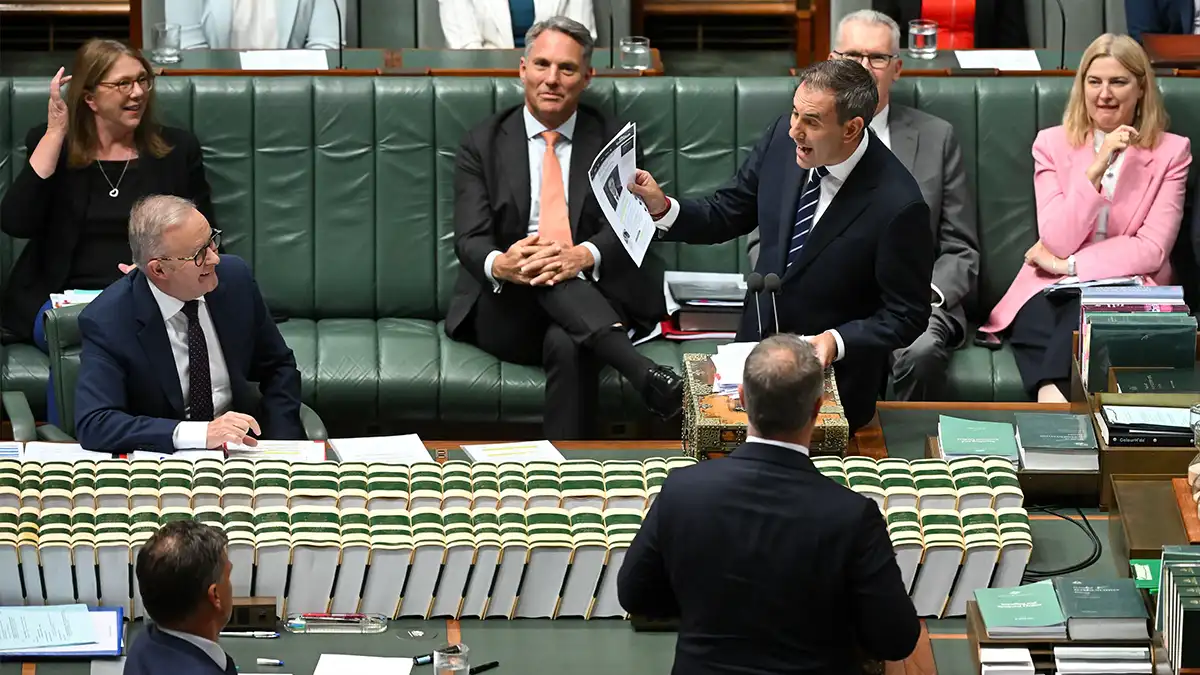
Treasurer Jim Chalmers has accused shadow treasurer Tim Wilson of holding investments that profit when Australia’s share market falls, escalating a heated economic exchange in federal parliament during question time.
The accusation came as the opposition renewed attacks on the Albanese government’s economic record, with Wilson and other Coalition MPs arguing that Australia’s living standards have declined compared with other advanced economies.
Responding to criticism from the opposition benches, Chalmers told the House of Representatives that Australia’s economic growth remained stronger than other advanced economies and pointed to the latest national accounts data showing an improvement in living standards over the past year.
“Australia’s economic growth is stronger than every other advanced economy,” Chalmers said in parliament.
“The living standards in today’s national accounts went up – they went up through the year.”
But the treasurer used his answer to turn the attack back on Wilson, holding up a printed report referencing scrutiny of the Liberal MP’s financial holdings.
“He has invested in shares which ensure the worse the Australian market and economy performs, the more money he makes out of it,” Chalmers told MPs.
The claim refers to an investment disclosed in Wilson’s parliamentary register of interests involving a financial product designed to rise in value when Australia’s benchmark share index falls. Such products – commonly known as inverse exchange-traded funds – are typically used by investors as short-term hedges against market downturns.
Wilson has previously said the investment was originally made during the early stages of the COVID-19 pandemic as a hedge against market volatility.
Financial analysts say these instruments are usually held only briefly to protect portfolios from short-term market swings. In Wilson’s case, the investment has been held for several years, an approach some experts describe as unusual given the long-term upward trend in equity markets.
The exchange in parliament came during a question time dominated by debate over the economy and cost-of-living pressures facing households.
Wilson earlier challenged the government’s economic management, arguing Australia had performed worse than comparable economies on inflation and living standards.
Coalition MPs repeatedly asked whether the prime minister should take responsibility for what they described as declining living standards during the government’s term.
Deputy Nationals leader Kevin Hogan also raised similar concerns, claiming Australia was the only advanced economy where living standards had moved backwards.
Chalmers rejected the criticism, saying the opposition had ignored recent economic data showing a modest recovery in real disposable incomes per capita.
“Listen up,” Chalmers said across the chamber as he addressed opposition MPs.
“You would think that having taken three days to ask a question about the economy, they might understand what’s happening with living standards.”
The exchange briefly inflamed tensions in the chamber, with opposition MPs responding with jeers from the benches.
Economic performance and cost-of-living pressures have become central political battlegrounds ahead of the government’s next federal budget, expected in coming months.
Chalmers has repeatedly argued that the Albanese government inherited high inflation and global economic instability following the pandemic and Russia’s invasion of Ukraine, but that Australia has since avoided recession and maintained strong employment growth.
According to government figures, more than one million jobs have been created since Labor came to office, while inflation has gradually eased from its peak.
However, the opposition maintains that many households are still facing significant financial pressure due to rising mortgage repayments, grocery prices and energy costs.
The clash between Chalmers and Wilson reflects a broader ideological contest over economic management, with Labor emphasising wage growth and targeted cost-of-living relief while the Coalition continues to attack government spending and inflation.
Parliamentary exchanges over economic policy are expected to intensify as the government prepares its next budget and both sides seek to frame the national debate on productivity, inflation and living standards.
